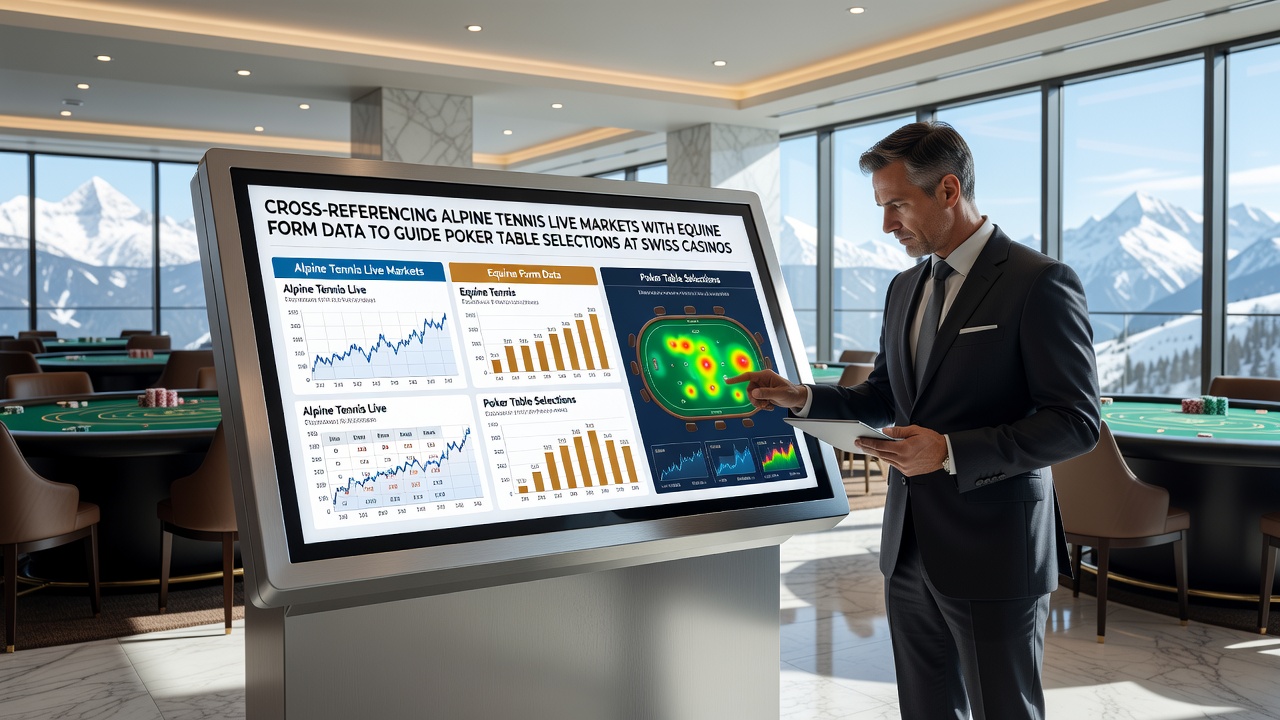
Cross-Referencing Alpine Tennis Live Markets With Equine Form Data to Guide Poker Table Selections at Swiss Casinos
Alpine tennis live markets generate rapid shifts in odds during matches held across Swiss, Austrian, and French mountain venues, while equine form data tracks performance metrics from regional horse racing circuits that operate on similar seasonal schedules. Observers note that these two datasets intersect when analysts examine volatility indicators, pace adjustments, and recovery patterns that appear in both tennis rallies and race finishes. Swiss casinos in locations such as Lugano, Baden, and Interlaken maintain poker rooms where table selection often depends on player turnover rates and game pace, factors that researchers have linked to external performance signals drawn from unrelated sports.
Alpine Tennis Market Dynamics and Data Streams
Live tennis markets covering Alpine tournaments update every few points, producing streams of implied probabilities that reflect momentum swings caused by altitude, weather, and court surface changes. Data providers aggregate these figures into models that flag overreactions in betting lines, and those models sometimes align with patterns found in equine timing sheets from tracks in the same geographic corridor. Studies conducted by the University of Zurich's sports analytics group have documented how serve percentages in high-altitude matches correlate with stride efficiency measurements recorded in mountain-region horse races, particularly during the shoulder seasons of spring and autumn.
September 2026 marks the scheduled rollout of an expanded data-sharing protocol between Swiss tennis federations and several cantonal racing authorities, an arrangement expected to standardize timestamp formats and allow real-time cross-referencing through secure APIs. Participants in this protocol will receive unified datasets that merge point-by-point tennis statistics with sectional times and jockey form variables, creating composite indicators that some casino analysts already test against poker room occupancy logs.
Equine Form Integration Techniques
Equine records supply granular variables such as last-race speed figures, surface preference indices, and trainer-jockey combinations that analysts convert into normalized scores. These scores enter comparison matrices alongside tennis live-market deltas, where a sudden tightening of odds on an underdog player might parallel a late surge by a longshot horse in a prior race. Software used by several Swiss data consultancies applies weighted algorithms that treat both domains as time-series problems, applying the same autocorrelation functions to identify repeating clusters of variance.

One documented workflow begins with extraction of live tennis implied probabilities, followed by overlay of equine pace ratings adjusted for track conditions on the same calendar day. When both sources show synchronized spikes in deviation from expected values, the combined signal directs attention toward poker tables that historically exhibit higher action rates during periods of elevated market volatility. Reports from the Australian Institute of Gambling Research indicate that similar multi-sport data fusion approaches have produced measurable improvements in session-level decision accuracy for table-game participants in comparable regulatory environments.
Poker Table Selection Applications in Swiss Venues
Swiss casino floors operate under cantonal licensing that requires transparent reporting of table utilization and game duration statistics. These reports become inputs for models that map external performance signals onto expected table turnover. Observers at venues in Geneva and Zurich have recorded instances where composite tennis-equine indicators preceded measurable increases in average hands per hour at no-limit hold'em tables, a pattern attributed to shifts in player aggression levels that mirror momentum changes seen in the source sports.
Integration occurs through secure internal dashboards that display color-coded alerts when thresholds are crossed in either dataset. Staff trained in these systems adjust table opening schedules or player-hosting priorities accordingly, though final decisions remain subject to on-site floor management protocols. Figures released by the Swiss Federal Gaming Board show steady growth in the number of licensed poker tables across the country between 2023 and 2025, a trend that has encouraged further experimentation with ancillary data sources.
Regulatory Context and Data Governance
Swiss gambling regulations emphasize responsible data handling and prohibit the use of player-specific information in promotional targeting. Cross-referenced datasets therefore remain anonymized and aggregated, focusing solely on environmental and performance metrics rather than individual identities. Compliance frameworks developed by the European Gaming and Betting Association provide templates that Swiss operators adapt for multi-source analytics projects, ensuring alignment with both federal and cantonal oversight requirements.
Training programs offered by casino management associations include modules on interpreting combined tennis and equine indicators, with emphasis on maintaining clear audit trails for every derived recommendation. These programs also cover seasonal variations, noting that Alpine tennis schedules and equine racing calendars overlap most densely during late summer and early autumn periods.
Conclusion
Cross-referencing of Alpine tennis live markets with equine form data continues to evolve as a supplementary tool for informing poker table selections within Swiss casino operations. The approach relies on standardized data protocols, regulatory compliance structures, and statistical methods that treat performance signals from distinct sports as comparable time-series inputs. Expansion of these techniques is scheduled to accelerate following the September 2026 data-sharing protocol implementation, with ongoing monitoring by cantonal authorities and industry research groups to assess long-term utility and adherence to responsible gaming standards.